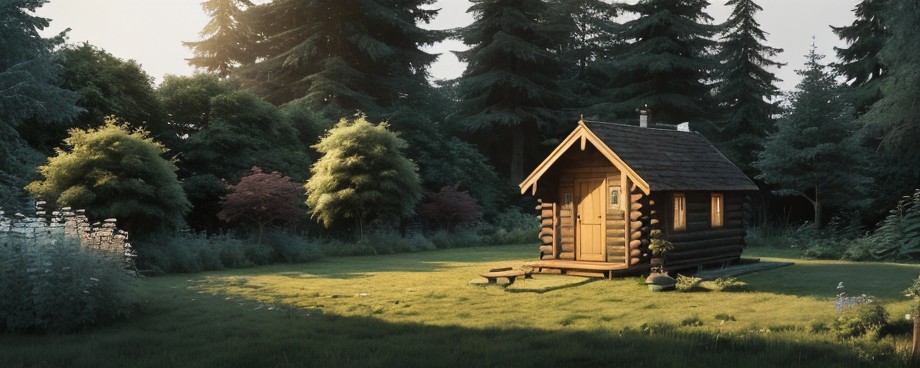
Returning to Old Land
A man took a long flight and arrived in a distant land — not entirely foreign, but the place where he had grown up. Some relatives had passed away, and he had inherited a small, beautiful garden with an old cabin on it. But he didn’t come for the inheritance. His life was already established elsewhere, on a larger and more comfortable property. He was content. He simply came to honor those who were gone.
Still, standing on that familiar soil, memories rose. He had spent countless hours here as a boy. Yet there was no pull, no desire to return, no impulse to sell it for profit. The land was lovely but modest, and his life now belonged somewhere else. So the decision felt natural: he would give the property to relatives who lived nearby. The sense of doing something right was worth far more than anything he could gain from it.
A Sense of Belonging Elsewhere
The Vedic worldview rests on a similar principle: a deep belonging to another, higher, more complete “place” — and through that belonging, a natural detachment from the temporary world we inhabit now.
A modern mind may object: How can you build your entire life on faith alone?
Today we imagine ourselves to be grounded in science and direct experience — things we trust because we can verify them.
But this objection quietly assumes that the “other reality” cannot be experienced.
That assumption is incomplete.
Indirect Experiences of a Higher Reality
Even if someone treats that higher reality as a matter of belief, it doesn’t mean it cannot be known. In fact, we all experience traces of it constantly, though in indirect and often tangled forms.
Qualities such as kindness, respect, generosity, the impulse to comfort, uplift, or protect — where do these actually originate? Why do they feel inherently meaningful and pleasant?
These are not accidents of biology.
In the Vedic and especially the Bhakti worldview, they are partial reflections of one coherent truth in which the heart is central.
Not money.
Not power.
Not competition.
Bhakti is essentially a worldview built out of those very qualities we usually encounter only in fragments — kindness, care, generosity, the impulse to support or uplift. What appear to us as scattered moments of goodness are, in that framework, pieces of a single integrated reality. They are not exceptions to how the world works, but hints of how it is meant to work when seen whole.
How Detachment Actually Operates
Vedic culture did not reject worldly engagement. There were bankers, merchants, soldiers — all the roles needed for society to function. A heart-centered worldview doesn’t deny material life; it orients material life toward what genuinely nourishes the heart.
Just as the man in the story once used the garden to grow and learn, but later moved on to a richer land, one who grasps a higher reality naturally loosens their grip on this one.
What This Means for Us Today
What might “detachment” look like in modern society?
It doesn’t mean passivity or abandoning ambition.
It means cooling the frantic race for finite resources.
It means reducing the aggression built into our systems.
It means remembering that people — not positions — are the point.
Even this simple shift would dissolve many of the pressures that drive us toward conflict. I’m not describing an utopia where competition disappears entirely. Some competition is healthy. But right now, globally, we are clearly out of balance. Wars continue. Institutions wobble. Stability — both inner and outer — feels thin.
To me, this is the signal:
we have drifted far from the place we truly belong — and the consequences of that disconnection are now unfolding everywhere.