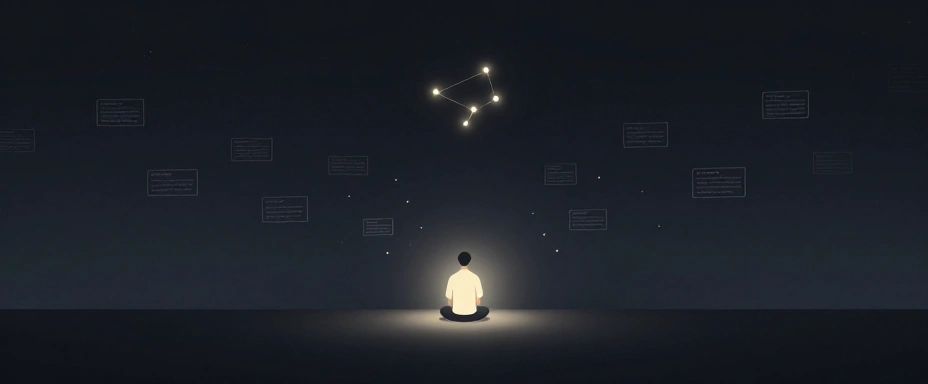
The On-Demand Assumption
We’ve quietly come to expect knowledge to behave like a vending machine.
Press a button, get an answer.
Type a question, receive a response.
With search engines—and now large language models—we’re closer than ever to that ideal. Ask anything, get something instantly. Knowledge, it seems, is finally on demand.
And yet, something doesn’t add up.
You can read the same explanation twice—once it feels obvious, even profound. Another time, it feels flat, confusing, or even wrong. You can ask an AI a question and get a perfectly reasonable answer, but feel nothing from it. No clarity. No shift. Just words.
If knowledge is truly “on demand,” why doesn’t understanding behave that way?
A Missing Factor
One way to approach this is to question an assumption we rarely examine: that all knowledge is simply information waiting to be accessed.
In the Bhagavad Gita (18.14), Krishna describes action as arising from five factors:
- the field or situation (adhiṣṭhāna)
- the doer (kartā)
- the instruments (karaṇa)
- the effort (ceṣṭā)
- and a fifth factor: daivam
This last one is often translated as fate, divine influence, or simply the unseen factor.
Modern thinking is extremely good at working with the first four:
- we optimize environments
- refine tools
- increase effort
- and strengthen individual agency
But the fifth factor—daivam—doesn’t fit neatly into a system that values control and repeatability. So it’s often ignored, or at least left unspoken.
And yet, it shows up precisely where things matter most.
Access vs Understanding
Consider the difference between having access to knowledge and understanding it.
Access is now trivial. Understanding is not.
There seems to be a threshold—a point at which something “clicks.” Before that point, explanations don’t land, no matter how clearly they are presented. After that point, even simple statements can feel deeply illuminating.
Traditional frameworks use a concept called adhikāra to describe this. It refers to a kind of readiness—not just intellectual, but situational and internal. Not everyone is equally prepared to grasp a given idea at a given time.
This isn’t about intelligence or effort alone. You can try hard and still not understand. You can also encounter something casually and suddenly see it clearly.
This helps explain something we all recognize but rarely articulate:
Not all knowledge is available on demand.
Some forms of understanding are event-based, not continuous. They depend on readiness and timing as much as on access.
Where the Model Breaks
This doesn’t invalidate modern approaches to knowledge—it just limits their scope.
The “on-demand” model works extremely well for domains where:
- variables can be isolated
- results can be reproduced
- and meaning is not dependent on the observer
But it struggles in areas like:
- self-understanding
- interpretation
- meaning-making
In these domains, knowledge behaves less like a vending machine and more like a season.
You can prepare the ground. You can plant seeds. But you can’t force the harvest.
This may also explain why certain forms of knowledge—once widely respected, such as astrology or deeper strands of religious philosophy—don’t translate well into modern, productized formats. Attempts to standardize, scale, or “deliver” them on demand often fall flat.
And yet, historically, these same domains functioned for centuries through slower, more contextual transmission—often person-to-person, insight by insight.
Perhaps this is where that fifth factor—daivam—quietly re-enters the picture. Not as something mystical or arbitrary, but as a reminder that some forms of understanding cannot be forced, only received when conditions align.
AI and the Visibility of the Gap
Ironically, the rise of AI makes this more visible, not less.
We now have near-instant access to answers. But this only highlights the gap between information and understanding. The former is abundant; the latter still arrives unpredictably.
Sometimes, everything lines up—and something shifts.
Other times, nothing happens at all.
That inconsistency isn’t a flaw in the system. It may be a feature of reality itself.
Seasonal Knowledge
We’ve become very good at making knowledge accessible.
We’re still learning that not all knowledge is meant to be immediate.
Some of it waits—for the right configuration, the right moment.
Not all knowledge is a soda machine.
Some of it is seasonal.