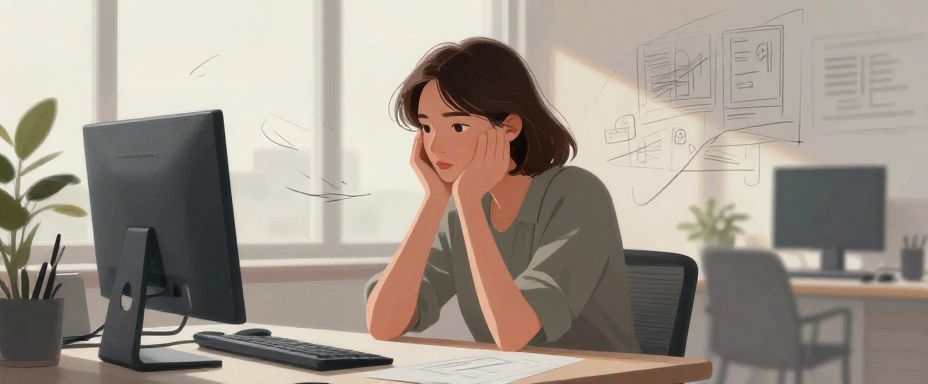
We like to think we live in the present.
But notice what actually fills a normal day.
Sometimes life is happening somewhere ahead:
“I’ll feel okay when I finish this… when I get things under control.”
Sometimes it’s happening somewhere else entirely:
“Let me not feel this right now.”
So we reach for something—our phone, a show, a memory, a mood.
And only rarely—quietly, almost accidentally—life is just… here.
A sunset. A conversation. A simple moment that doesn’t need anything added to it.
The Vedas describe these patterns as the three modes of nature—gunas.
Not as abstract philosophy, but as something we move through every day.
Mode 1: Living for What’s Next
There’s a mode where your life is always one step ahead of you.
You see what could be better. You make plans. You improve things. It feels purposeful—like you’re shaping your future.
And to some extent, you are.
But there’s a hidden constraint.
It’s like being inside a well-designed game. You have freedom, choices, variation—but all within a system you didn’t create. You can climb, achieve, improve… but not step outside the structure itself.
So every achievement follows a familiar pattern:
you want it, you reach it, and then—after a while—it flattens.
Sometimes you don’t even get there—your desires shift halfway through.
Either way, it doesn’t fully land.
Not because it was meaningless.
But because it was never the final step.
So the mind moves again:
“Maybe the next one.”
Mode 2: Living Anywhere But Here
Then there’s the opposite mode.
Not chasing the future—escaping the present.
You scroll, distract, replay memories, sink into moods. Not necessarily because you’re lazy, but because you’re trying to feel something different than what’s here.
It can look like rest.
But it’s usually relief.
A way to soften discomfort, or to manufacture emotion when reality feels flat.
In this mode, life isn’t ahead of you.
It’s replaced.
Both Are a Kind of Absence
These two modes look very different.
One is active, the other passive.
One builds, the other avoids.
But they share something subtle:
In both, the present moment isn’t enough.
It’s either a stepping stone…
or something to get away from.
Mode 3: When Nothing Needs to Be Added
There’s another mode that feels almost unfamiliar at first.
Not because it’s rare—but because we don’t stay there long.
It’s the moment where experience itself is enough.
Nothing needs to be improved.
Nothing needs to be escaped.
Things may not be perfect on paper—but they don’t need to be.
They already feel coherent. Clear. Harmonized.
You’re not trying to get somewhere else, or generate a different feeling.
You’re just here.
And strangely, that’s peaceful and fulfilling.
The Limit of Clarity
It’s tempting to think this is the end of the search.
If I can just stay here—present, clear, at peace—then that’s it.
But even this has a subtle boundary.
Not philosophical—practical.
Notice this:
Even in your most peaceful, clear moments…
you’re still the one maintaining them.
You return to presence when you drift.
You regulate your reactions.
You keep things “clean” inside.
It’s calm—but quietly effortful.
Like a room that stays perfectly clean… because you’re always, subtly, maintaining it.
And you can feel it most clearly when something disrupts it.
A difficult emotion.
A sudden conflict.
Unexpected chaos.
There’s a moment of friction:
“Wait… this shouldn’t disturb me.”
That’s the giveaway.
You weren’t just experiencing peace.
You were holding a state.
A Different Kind of Step
Now compare that to something very simple.
A moment with someone you deeply trust.
Or love.
For a moment, you forget to manage yourself.
You’re not:
- maintaining clarity
- watching your state
- trying to stay aligned
You’re just… there in the relationship and in the moment.
And strangely, that can feel even more full than peaceful clarity.
Because something has shifted:
You’re no longer the center holding the experience together.
You’re inside something.
There’s a possibility that doesn’t follow the same pattern as the others.
Not improving the future.
Not escaping the present.
Not even stabilizing clarity.
But stepping out of being the one who is managing the experience at all.
At first, this feels like a risk.
Like letting go of something essential.
The question comes up naturally:
“If I stop holding this together… what happens to me?”
And yet, there’s also a pull.
Because every other mode, in its own way, is limited.
- The future never fully satisfies.
- Escape never fully resolves.
- Even clarity has to be maintained.
So the possibility appears:
What if the next step isn’t doing it better…
but not being the one doing it?
Closing
We spend most of life trying to improve the experience.
A better future.
Better feelings.
Better clarity.
But there’s a quieter direction that doesn’t fit that pattern at all.
Not improving the experience—
but loosening the grip on being its center.
And that shift begins where experience becomes relationship—that’s where bhakti starts.